Blockchain-Enabled Chain-of-Custody for Sterile Injectable Distribution
Delivered a permissioned Hyperledger blockchain that gives a multinational pharmaceutical manufacturer real-time, tamper-evident chain-of-custody and cold-chain verification from batch release through pharmacy dispense — cutting recall trace time by 92% and closing the gap that had let diversion incidents go undetected.
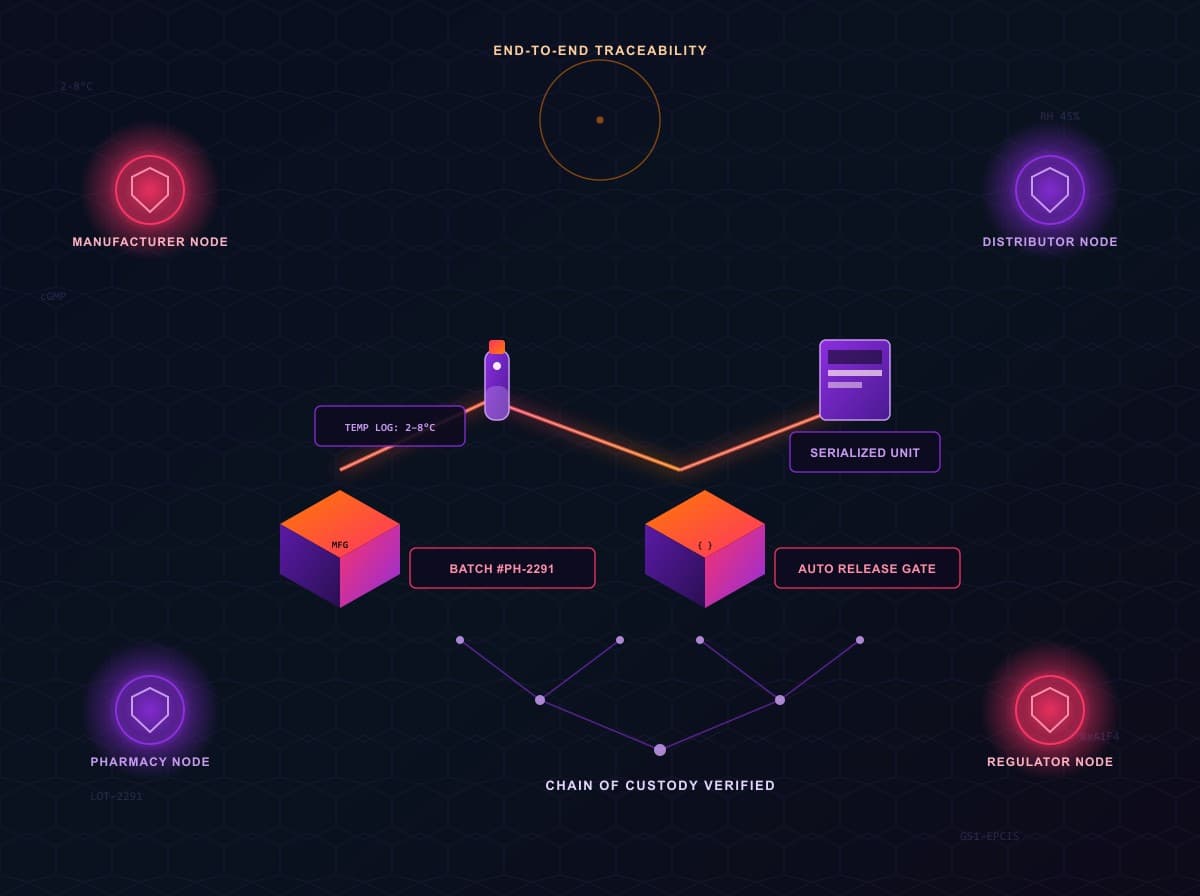
This case study is an illustrative composite drawn from patterns we see across pharmaceutical manufacturing and distribution engagements; client details have been anonymized and combined to protect confidentiality. The client is a multinational specialty pharmaceutical manufacturer producing temperature-sensitive injectable therapies distributed across more than a dozen regulatory markets. The manufacturer's existing track-and-trace process stitched together disparate ERP exports, third-party logistics manifests, and manual pharmacy verification calls, so reconstructing a single batch's chain of custody could take days — and even then relied on paper temperature logs that regulators and channel partners had no independent way to verify. A handful of gray-market diversion incidents in secondary markets, plus tightening serialization mandates (DSCSA-aligned track-and-trace in the U.S., EU FMD equivalents elsewhere), turned the manual process from an inconvenience into a compliance risk and a growing cost center. We designed and delivered a permissioned blockchain ledger that records every custody transfer — manufacturing release, distributor receipt, cold-chain checkpoint, and final pharmacy dispense — as a signed transaction, with each participating organization running its own validating node rather than trusting a single central database. Smart contracts encode the release rules directly: a batch cannot advance to the next custody stage unless its accompanying IoT temperature log stays within the validated 2-8°C range, and any excursion automatically flags the batch and halts the smart-contract-gated release instead of surfacing the problem after the fact. The ledger runs on Hyperledger Fabric, chosen over a public chain specifically for its channel-based data partitioning — competing distributors on the same network can transact with the manufacturer without seeing each other's volumes or pricing — and for meeting enterprise throughput and data-residency requirements a public Ethereum deployment couldn't satisfy here. A smaller, deliberately separate Ethereum-compatible layer handles a tokenized loyalty and rebate program for pharmacy partners, kept apart from the compliance-critical custody data path. Cold-chain IoT sensors write signed readings on-chain through a lightweight gateway service, and a GS1 EPCIS-compliant serialization layer ties every ledger entry back to the physical unit's existing barcode and lot number, so field staff never had to change how they scan a carton. Key features include real-time custody visibility scoped to each stakeholder's own permissioned view, automated cold-chain excursion alerts that halt smart-contract release before an out-of-range unit reaches a shelf, one-click recall trace that walks the ledger backward from any serialized unit to its originating batch and every intermediate custodian, and a regulator-facing read-only portal that satisfies serialization audit requests without granting write access to the production ledger. Because the ledger carries data subject to DSCSA, EU FMD, and Good Distribution Practice requirements, every node runs behind mutual TLS with hardware-backed key storage for transaction signing, and role-based channel permissions ensure a distributor's node can only read the custody records for shipments it actually touched. The system passed an independent security audit and a 21 CFR Part 11-aligned validation exercise before go-live, and the smart contracts governing release logic are version-pinned under the same change-control process as any other validated GxP system. Since rollout across the client's first three markets, full batch-to-dispense recall trace time dropped from an average of several days of manual reconciliation to minutes, and flagged cold-chain excursions are now caught before release in 100% of cases rather than discovered downstream. The manufacturer has onboarded 14 distribution and pharmacy partners onto the network, with zero confirmed counterfeit or diversion incidents traced through the blockchain-covered supply chain since launch.